Art, Faith, and the Renewal of Imagination
Lately I’ve been thinking about how we are meant to experience art. Not just to look at it and decide whether we like it, or whether it is technically good, but to allow it to move something inside us. From the beginning, art was never only decoration. It was a way of turning the human heart toward God. Beauty has always had a way of drawing us to worship.
If art can move us, even for a moment, it means the imagination has opened. Throughout Scripture, God speaks not only through words we hear, but through visions, dreams, imagery, symbolic encounters, and the eyes of the heart. The imagination is not a place of fantasy, it is one of the places where God meets us most tenderly and most powerfully. Jesus didn’t only teach with information. He used images, parables, symbols and metaphors because the imagination is a doorway into the inner life. When the imagination wakes up, the heart wakes up.
Today we have access to more teaching, podcasts, sermons and resources than any generation before us. It has never been easier to learn about God. But information alone doesn’t change us. Formation is slower. It reaches deeper. It shapes who we are becoming, not just what we know.
Formation asks a different kind of question. Not “Did I learn something new?” but “Did something shift in me?”
“Did I see differently? Desire differently? Become more Christlike?”
That’s where this course was born. Art has been forming me for years, quietly and deeply. Not by analysing paintings, but through encounter. Not through technique, but through His presence. I don’t believe the painting itself is holy, but I believe God speaks in more languages than words, including image, beauty and mystery. Sometimes a painting reaches places that information can’t.
Art, Faith, and the Renewal of Imagination is a six-week formational experience where art, scripture and silence meet. Each session centres on real paintings in the room, not pictures in a manual or on a screen. Participants are invited to slow down, look deeply and listen for God’s voice in what stirs within them as they look.
To give a sense of what the journey is like, here is an example:
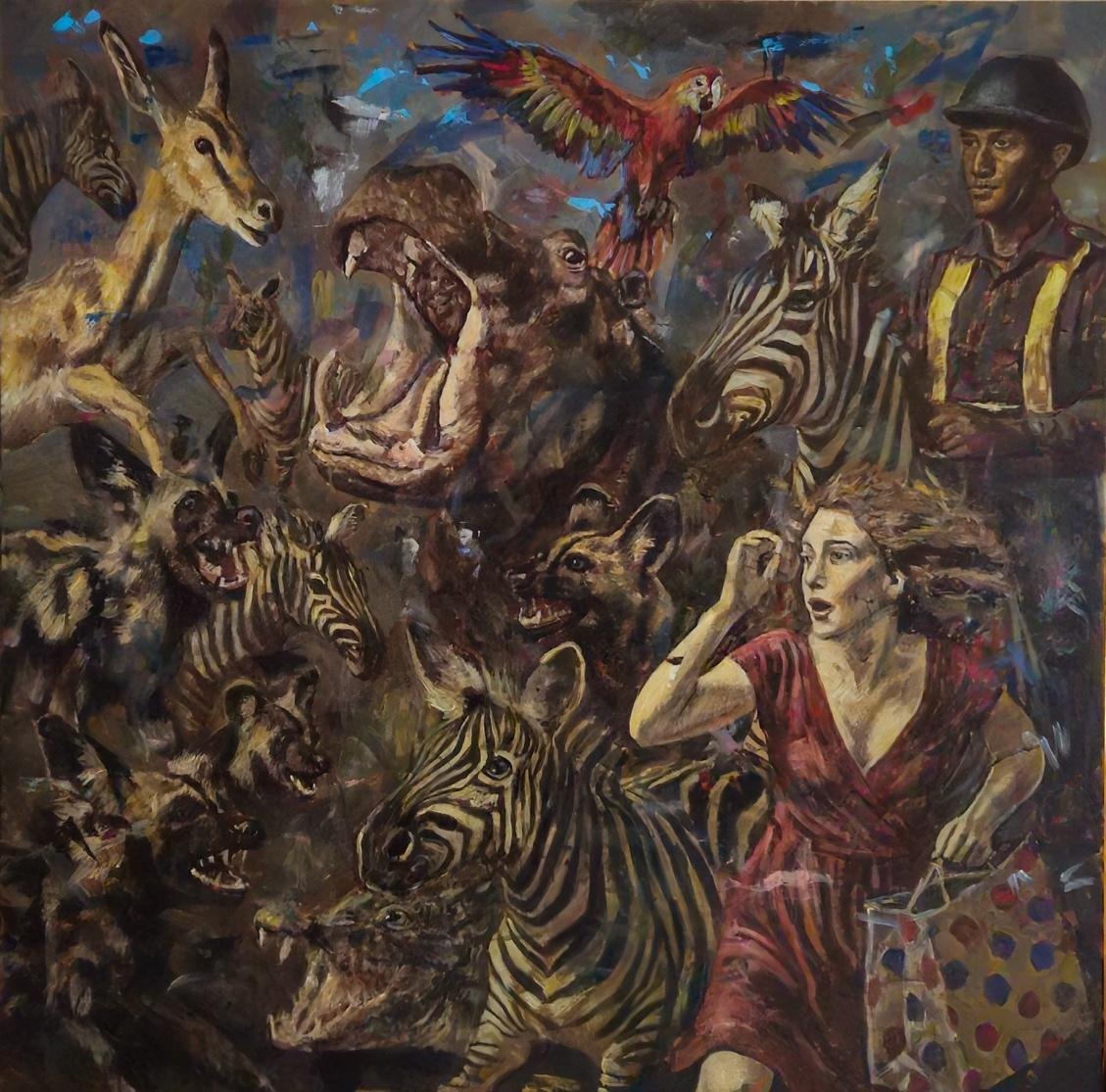
It’s a convergence of creatures; zebras, wild dogs, a hippo, a crocodile, a parrot, all rushing toward a single point. At the right corner, a woman in a red dress, caught mid-stride, suspended between fight and flight. Nothing is settled. Everything is arriving at once. It’s the kind of moment every person recognises, even if it looks different in our own lives.
Before reading further, take two minutes to pause and look in silence, ask Holy Spirit to speak to you. Notice what rises before your mind starts to explain it. Let imagination speak first.
Then we hold the image and scripture together:
“In this world you will have trouble. But take heart — I have overcome the world.”
— John 16:33
We are not trying to match the verse to the painting. We are listening for what the Spirit might surface when the two meet.
Three journaling questions:
- When everything converges at once, pressure, responsibility, fear, beauty, uncertainty. Where do you automatically turn for help or strength?
- What would it look like to “take heart” in the middle of the chaos, not only after the chaos?
- Write a sentence as if Jesus were speaking directly into that chaos. What does He say?
Creative prompt:
- Drawing: draw a single line or cluster of lines representing the direction of your gaze in that moment — inward, downward, outward, upward or toward Christ.
- Writing: complete this sentence: “When everything came to a head at once, I found myself…”
Don’t edit it. Don’t fix it. Just let the imagination speak. This is the rhythm of the course: stillness, art, scripture and imagination. Not an escape from reality, but a way of recognising Jesus within it. Not learning about Christ from a distance, but becoming more attentive to His presence in beauty, brokenness, culture and the quiet stirrings of the Spirit within us. You do not need to be an artist to take this course. You just need an imagination, and every person has one. My hope is that imagination becomes part of discipleship again. That art becomes a doorway to worship. That looking becomes listening. And that something in us does not just make sense, it shifts.